What is Winter Gold?
Winter Gold is a 3D winter sports game on a 16-bit console. Funcom, then Norway's biggest game developer, made it for Nintendo, which published it in Europe on 28 November 1996. It runs on the Super FX2, an enhanced version of Argonaut's Super FX chip that Doom and Yoshi's Island had used, in a 16-megabit cartridge.
How does Winter Gold play?
You pick a nationality and the colour of your suit, helmet and boots, then one of three modes: Practice, Competition (both against a chosen opponent, with best times saved on the cartridge) or Circuit, where finishing in the top three at each Olympic venue moves you on to the next. Up to eight people can take part.
- Snowboarding: a halfpipe against a strict time limit, scoring tricks and combos made with button combinations.
- Aerial skiing: like the snowboarding, but off a ramp, and you have to land well.
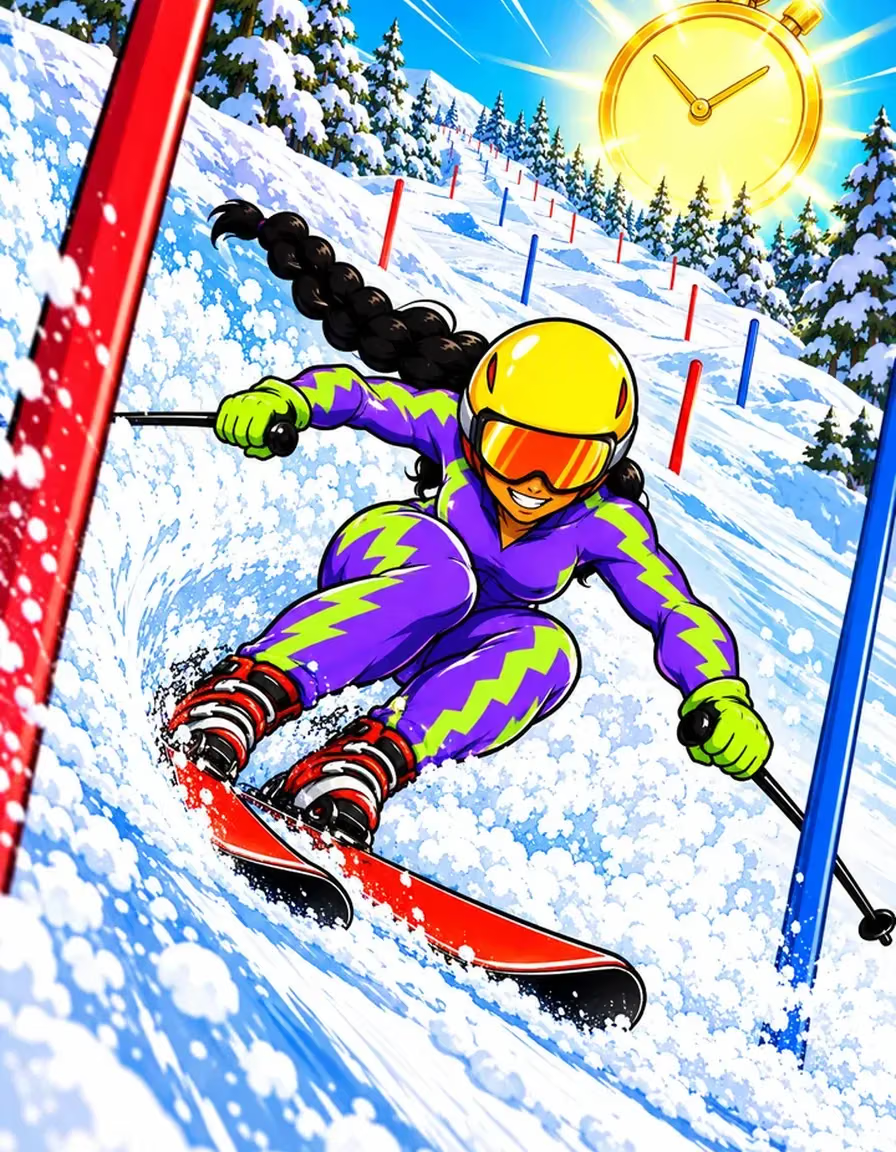
- Downhill: through the red gates, avoiding obstacles, with a push-off from the gate on the d-pad.
- Ski jumping, bobsleigh and luge: distance and style in the first, speed and avoiding the walls in the sliding events.
- Venues: Albertville, Lillehammer and Salt Lake City, with Nagano to unlock.
From English Wikipedia, citing Hobby Consolas, Nintendo Acción and the manual, read 11 Nov 2026.
How Winter Gold was made
Producer Erik Gloersen first wanted an official game of the 1994 Lillehammer Olympics, Funcom's home country's Games, under the working title FX Skiing; that never happened, but the winter sports game did. Lead programmer Olav Mørkrid recalled asking why make one when the others weren't good, and Gloersen's answer that that was exactly why (as English Wikipedia reports their 2018 interview).
Lead artist Rune Spaans, hired in 1994, describes on his own site how the team turned the backgrounds and video into vector graphics and animated the athletes in 3D, so well that people thought it was filmed. The scenery was built in 3D Studio on PCs, and the characters on a Silicon Graphics workstation with Alias PowerAnimator that Nintendo supplied, at a cost of $50,000. To avoid the on-rails feel of games over video backgrounds, they built courses from eight interchangeable pieces joined at matching frames, so the tracks could be endless. Jeroen Tel of Maniacs of Noise wrote the techno-house soundtrack.
What the critics said at the time
United Kingdom: 1 review
- UK
GamesMaster
38/100No. 48, Nov 1996, p. 49 · Les Ellis
Europe: 6 reviews
- ES
Hobby Consolas
85/100Fast polygon graphics, good sound and fun to play; the colours aren't very bright.
No. 62, Nov 1996, pp. 122–123 · Roberto Lorente
- ES
Superjuegos
90/100No. 55, Nov 1996, pp. 90–92 · Javier Iturrioz
- DE
Total!
No scoreGraded 3− on the German school scale (as cited by Wikipedia): good gameplay, polygons and techno music, little replay value.
No. 43, Jan 1997, p. 34 · Frederic Berg
- DE
MAN!AC
53%Funky presentation and fast events, but a poor palette and a letterboxed picture.
No. 40, Feb 1997, p. 73 · Martin Gaksch
- DE
Video Games
74%Very impressive 3D for the Super NES and inventive events, but little to do beyond beating your own times.
No. 63, Feb 1997, p. 99 · Thomas Wiesner
- DE
Mega Fun
68%No. 54, Mar 1997, p. 90 · Christoph Pütz
Elsewhere: 1 review
- AU
Hyper
76%No. 34, Aug 1996, pp. 36–37 · Stretch Armstrong
How was Winter Gold received?
Mixed, and split by country. Spain's magazines loved it, Superjuegos with 90 and Hobby Consolas with 85; Australia's Hyper gave 76% and Germany's Video Games 74%. Others were cooler: MAN!AC gave 53%, complaining of the palette and the letterbox, and Britain's GamesMaster only 38. The common praise was for the speed and the 3D, the common complaint that there was little to keep you playing.
Can you play Winter Gold today?
Only on the original PAL cartridge. It isn't in Nintendo Classics, the Super Nintendo library for Switch Online members, and it has never been re-released.



Comments